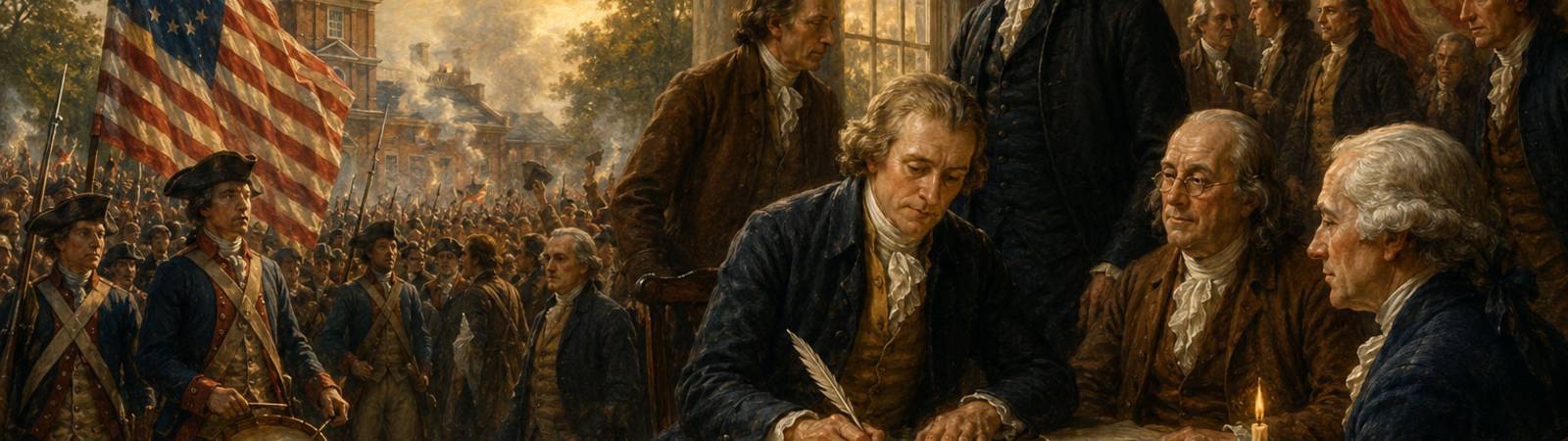
Words that Changed the World
By Russ Gifford
Right now, America is celebrating its 250th anniversary. As well it should. But when we celebrate the American Revolution, we speak of Lexington and Concord, Paul Revere, George Washington crossing the Delaware, and the terrible hardships endured by the men at Valley Forge. We hear Nathan Hale's final words, Molly Pitcher's extraordinary efforts under fire, Betsy Ross's devotion to duty, and Abigail Adams rousing neighbors to keep vital necessities flowing to the front lines.
Rightfully so - the actions of these valiant men and women remain vital to the battle of arms that would lead to the victory. The force of arms was carried by those who carried the arms.
But the true revolution was the revolutionary idea of the rights possessed by all men and women.
But those ideas were equally revolutionary to many Americans - though they were not called that yet. They thought they were British subjects. But the actions of the Crown had called that idea into question.
Were we British subjects - with the rights of all British subjects - or were we something else?
The King and the Parliament that passed first special taxes, and then the ‘Intolerable Acts' that bottled up Boston's harbor certainly thought the Colonists were something other than citizens.
The troops that killed protesters on the streets of Boston certainly didn't care who they were.
That question would become the bedrock on which the revolution would stand - or fall. As America reaches for its 250th anniversary, we will look back at those ideas, and the people who rocked the world by fighting that war of words. The outcome would decide the future of America - and the world.
Part 1: Franklin, Adams, Jefferson, and the Declaration of Independence
September 21
He is the best known American in the World in his time. He, like Washington, also considers himself a British citizen. Ben Franklin, the representative to Parliament for the colonies had tried for a decade to appeal to reason. Yet from the ascension of King George the Third, the Crown directed a rise of special taxes in the colonies, each worse than the previous one. But when the King directed troops to the colonies to stop the angry demonstrations against these taxes, Franklin warned them: If British soldiers are sent into the colonies, "They will not find a rebellion; they may indeed make one."
By 1775, Franklin conceded the war was imminent, and left England. On the day he lands in Philadelphia, he is elected to the second Continental Congress, called together to find a path forward. He will serve with John Adams, Thomas Jefferson, and a host of other luminaries – and his role there will be as vexing as his previous post. For the war of words in Congress will soon be faced with the rebellion Franklin had predicted.
But if the members on the street are uncertain of their status with England – many of their representatives are equally torn on how to proceed. Even as musket balls flew in Lexington and Concord, debates over the standing of the colonies as citizens of the crown reverberated in the halls of Congress.
We will hear from Franklin, from Adams, and from Jefferson – along with many others, as the War of Words moves from the long held effort to get the Crown to see reason, to the documentation of the abuses that the colonies would no longer tolerate. The war of words would finally move from consideration to a declaration that all people have rights that come from nature, not from government. Among those rights – the right of a liberty to pursue happiness. As a natural right of life, government could not take that right from them. It was a profound idea and one that had never been declared before that moment.
But once stated, the idea did not stay in the American colonies. It traveled around the world as fast as the papers quoting those words could be carried across the ocean. The words would all but fly from Philly to the four corners of the world. And the world would never be the same.
Part 2: Thomas Paine and Common Sense
September 28
While the Declaration of Independence had bravely declared their intent to carry the war to the British, and the people mostly responded positively to the call, after Lexington and Concord, there were major problems. How did the colonists feel on this subject? Congress may vote to declare independence, but it is the public that must bring the fight and suffer the consequences.
These revolutionaries faced the single most powerful army in the world, and that army quickly dispatched the farmers and would be fighters that had only stood briefly before running. As Washington’s ragtag army is kicked off the battlefield in New York, the men scatter to sneak back home as the remaining army dwindles in the rout.
Was the rebellion already over?
It could have been – but there was a battle of ideas and ideals being fought off the field. It was happening in newspapers and in pamphlets handed out on street corners and in taverns, or any place else people would gather. The people reading those papers would be the ones that decide the ultimate outcome of this Revolution.
It is at this point when Thomas Paine enters the war of words – and carries the battle. Who?
Looking back on the revolutionary era, John Adams would write, “I don’t know whether any man in the world has had more influence on its inhabitants” than Thomas Paine. That is no small claim, considering Adams’ own efforts for his country.
Paine wrote for the masses, using stirring phrases, vigorous style, and most importantly, applying “common sense” to his arguments. And the masses responded.
Writing pamphlets that boosted morale during the darkest days for the Revolution it is Thomas Paine who convinced the colonists that this war was their war. It is Paine that convinces the common man that this was the moment to declare their independence and to join the troops on the field.
As Adams notes, it was Thomas Paine who was fighting the war of words. And he was winning.
In this lecture, we will hear the words of Thomas Paine, and see how he pulled the young revolution through “times that try a man’s soul.”
Part 3: Farmers, Framers and Revolutionary Thinking
October 5
As the revolutionary war ends, it is the challenges of governing that will honestly require truly revolutionary thinking. It is one thing to declare your freedom. It is a completely different thing to construct a framework to marry the ideals to practical necessity.
We know that to be true – we stumble over it daily.
We will hear the words that stirred men to think deeper, and embrace the risk of the unknown and the unknowable. We will hear from the framers, who braced to dig deeper to make certain they had a solution.
And the practical people that recognized the key considerations that must be met. We will read the last war of words – the pamphlets and the letters that exhorted the thinks, and excoriated their ideals ‘in order to form a more perfect union.’
And in this, we will be celebrating the most powerful and important ideal of the revolution – the freedom to exchange ideas and vote on the solution.
Because it was the freedom to publish those ideas, to be heard and to be considered, that makes us different than all that came before us.